
|
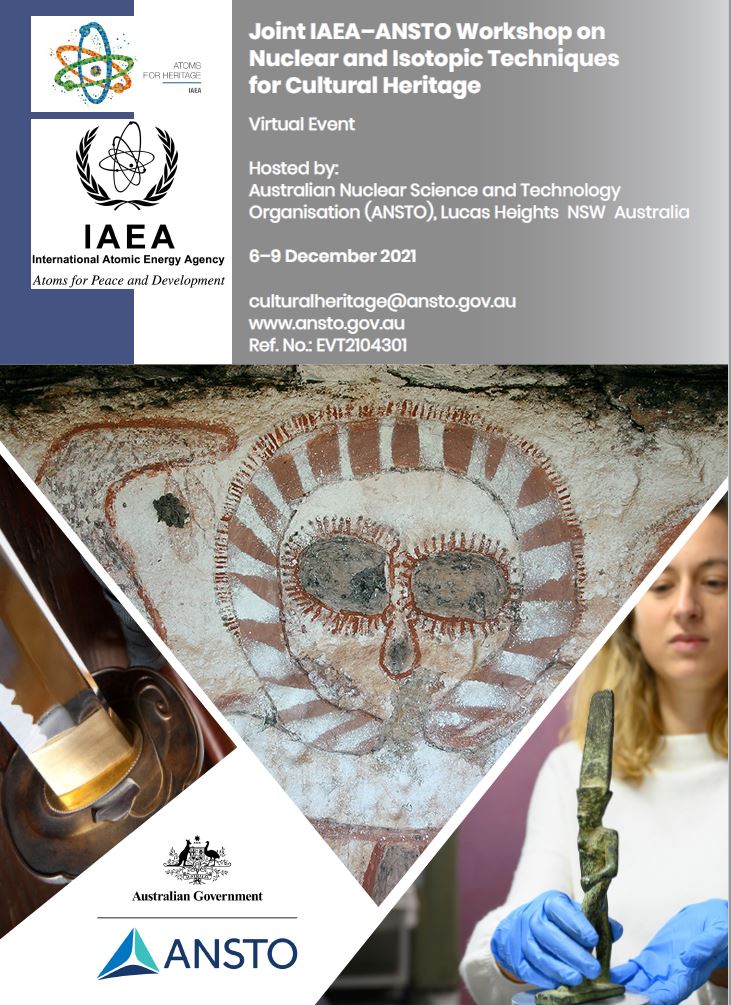
The overall objective of this Workshop was
to provide a forum for physicists, material scientists, chemists, archaeologists, conservators, curators, and heritage science stakeholders.
The objective was to contribute to the enhancement of scientific-technological knowledge, innovation infrastructure and human resources training in the area of cultural heritage using nuclear and isotopic techniques.
The event also aimed to provide a platform to further enhance the nexus between Arts and Science by promoting linkages between the collaborating centre activities and regional collaborators.
|
Key topics
Neutron and synchrotron X-ray imaging for structural tri-dimensional characterization;
Full-pattern Neutron Diffraction technique for structure and phase determination, Neutron Diffraction Residual Stress and Texture;
Analysis for the characterization of the preferred orientation and lattice deformations of the crystalline structure to clarify the manufacturing processes;
Neutron activation analysis for provenance study;
Ion Beam Analysis (IBA) for elemental analysis;
Accelerator Mass Spectrometry (AMS) as an ultra-sensitive method for isotopic dating;
THz/Far-IR spectroscopy for the characterization of pigments and other cultural heritage materials;
X-ray Fluorescence microscopy maps for elemental distribution and for a range of spectroscopic applications such as determining oxidation state and speciation;
Scanning electron microscope (SEM), focused ion beam (FIB), and transmission electron microscopy (TEM);
Overview of the most utilised portable equipment for the investigation of cultural heritage;
Introduction to the IAEA e-learning platform and courses on Heritage Science;
Mechanism to access research infrastructure and how to write a successful proposal
Further Workshop Information
Workshop Information Booklet
Book of Abstracts
