II.18.
Table 8 contains OILs for assessing the results of field monitoring of contamination of the ground, skin and clothing. Three types of OIL are provided in the units measured by field survey instruments: dose rate (OIL(γ)); beta counts per second (counts/s) for beta radiation (OIL(β)); and alpha counts/s for alpha radiation (OIL(α)). An OIL is exceeded if any of its types are exceeded. These OILs apply for emergencies involving all radionuclides, including fission products released by melting reactor fuel.
TABLE. 8. Default OILs For Field Survey Measurements
OIL |
OIL value |
Response action (as appropriate) if the OIL is exceeded |
|---|---|---|
Environmental measurements |
||
OIL 1 |
Gamma (γ) 1000 Sv/h at 1 m from surface or a source 2000 counts/s direct beta (β) surface contamination measuremente 50 counts/s direct alpha (α) surface contamination measurementf |
|
OIL 2 |
Gamma (γ) 100 μSv/h at 1 m from surface or a source 200 counts/s direct beta (β) surface contamination measurementf 10 counts/s direct alpha (α) surface contamination measurementf |
|
OIL 3 |
Gamma (γ) 1 μSv/h at 1 m from surface 20 counts/s direct beta (β) surface contamination measurementf,i 2 counts/s direct alpha (α) surface contamination measurementf,i |
|
Skin contamination |
||
OIL 4 |
Gamma (γ) 1 μSv/h at 10 cm from the skin 1000 counts/s direct beta (β) skin contamination measurementf 50 counts/s direct alpha (α) skin contamination measurementf |
|
Note: The OILs should be revised as soon as it is known which radionuclides are actually involved. The OILs should also be revised, if necessary, as part of the preparedness process, to be more consistent with the instruments to be used during the response. However, the default OILs in this table can be used without revision to make a conservative assessment immediately.
a Inside closed halls of large multi-storey buildings or large masonry structures and away from walls or windows.
b If immediate decontamination is not practicable, advise evacuees to change their clothing and to shower as soon as possible. Guidance on performing decontamination can be found in Refs [18, 21].
c Advise evacuees not to drink, eat or smoke and to keep hands away from the mouth until hands are washed.
d Local produce is food that is grown in open spaces that may be directly contaminated by the release and that is consumed within weeks (e.g. vegetables).
e This external dose rate criterion applies only to sealed dangerous sources and does not need to be revised in an emergency.
f Performed using good contamination monitoring practice.
g Restricting essential foods could result in severe health effects (e.g. severe malnutrition), and therefore essential foods should be restricted only if replacement food is available.
h Use 10% of OIL3 for milk from small animals (e.g. goats) grazing in the area.
i Deposition by rain of short lived naturally occurring radon progeny can result in count rates of four or more times the background count rate. These rates should not be confused with the deposition rates due to the emergency. Count rates due to radon progeny will decrease rapidly after the rain stops and should be back to typical background levels within a few hours.
j Only for several days and only if replacement food is not available.
k Fission products that were produced within the last month, thus containing large amounts of iodine.
II.19.
The OILs in Table 8 were established for implementing the protective actions and other response actions in a way consistent with the generic criteria in Tables 2 and 3. In the development of these OILs, all members of the population (including children and pregnant women) as well as all usual activities (such as children playing outdoors) were considered. The OILs were calculated to ensure that the protective actions to be taken protect against the most radiotoxic radionuclides. As a result, the OILs are overly conservative for many radionuclides and should be revised as soon as it is known which radionuclides are involved.
II.20.
As a minimum criterion, a contamination monitoring instrument is considered suitable for applying the OIL if it will provide a response equal to or more conservative than that assumed in development of the OILs. The following procedure may be used for checking whether or not a particular instrument meets the minimum criterion and can be used in applying the operational criteria for OIL1, OIL2 and OIL4 in Table 8:
Ensure that the instrument can display counts/s (or counts/min) over the ranges of the OIL values in Table 8.
For a beta monitor, ensure that it can detect both high (e.g. 32P) and low (e.g. 14C) energy beta emitters. It is not required that very weak emitters (e.g. 63Ni) be detectable.
Calculate the instrument coefficients (ICs) using measured (i.e. derived from the calibration factor) or known 4π efficiencies (e.g. those provided by the manufacturer) for high energy and low energy beta emitting radionuclides and an alpha emitting radionuclide (as applicable) using the formula:
where
IC is the instrument coefficient ((counts/s cm2)/Bq);
Wmonitor is the effective area of the detector window (cm2);
θmonitor is the energy dependent efficiency for 4π geometry close to the surface and under ideal conditions (counts/s ˟ Bq–1).
If the calculated IC values are greater than or equal to the following, the instrument is suitable:
For medium or high energy beta emitters (e.g. 36Cl) — 1;
For low energy beta emitters (e.g. 14C) — 0.2;
For alpha emitters — 0.5.
A beta monitor should meet both the high energy and the low energy beta criteria.
These criteria were established so that the majority of commonly available contamination monitoring instruments will give a response that is equal to or higher (i.e. more conservative) than the response assumed in developing the default OILs. However, the response of instruments that meet these minimum criteria may vary by a factor of as much as 20, primarily owing to differences in the effective area of the detector. Therefore, the OILs in Table 8 should be revised, if necessary, to be more consistent with the characteristics of the instruments to be used during the response. This should be done as part of the preparedness process.
II.21.
The process of assessing radionuclide concentrations in food, milk and water is shown in Fig. 5. First the potentially contaminated food should be screened over a wide area and analysed to determine the gross alpha and beta concentrations if this can be done more promptly than assessing the concentration of individual radionuclides. If the OIL5 (see Table 9) screening levels are not exceeded, the food, milk and water are safe for consumption during the emergency phase. If an OIL5 level is exceeded, the radionuclide specific concentrations in the food, milk or water should be determined. If the OIL6 levels in Table 10 are exceeded, consumption of non-essential food, milk or water should be stopped, and essential food, milk and water should be replaced or the people should be relocated if replacements are not available. Finally, as soon as possible the guidance in Ref. [29] should be used to determine whether the food, milk or water is suitable for international trade, and national criteria or WHO guidance [30] should be used to determine whether the food, milk or water is suitable for long term consumption after the emergency phase.
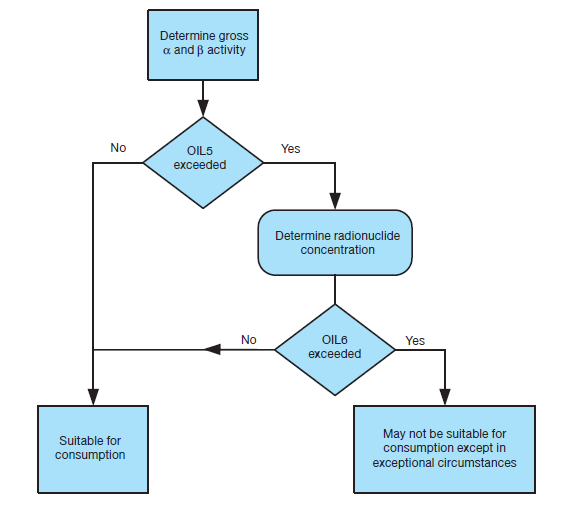
FIG. 5. Process of assessing radionuclide concentrations in food, milk and water.
II.22.
Tables 9 and 10 give OILs for assessing food, milk and water (see also Table 11). These OILs apply to radionuclides in food, milk and water destined for human consumption (they are not applicable for dried food or concentrated food). The food, milk and water OILs in Tables 9 and 10 were calculated on the basis of the following conservative assumptions:
All of the food, milk and water are initially contaminated and are consumed throughout a full year.
The most restrictive age dependent dose conversion factors and ingestion rates (i.e. those for infants) are used.
The generic criterion of 10 mSv per year (and not 100 mSv per year, as in Table 3, at which early protective actions are to be taken) was used to ensure that those people in areas from which they were not relocated will not receive a total dose (including the dose from ingestion) greater than 100 mSv per year.
TABLE. 9. Default Screening OILs For Food, Milk and Water Concentrations from Laboratory Analysis
OIL |
OIL value |
Response action if the OIL is exceeded |
OIL5 |
Gross beta (β): 100 Bq/kg or Gross alpha (α): 5 Bq/kg |
Above OIL5: Assess using OIL6 |
Below OIL5: Safe for consumption during the emergency phase |
table 10
table 11
II.23.
Radioactive 40K is commonly found in food and water. It does not accumulate in the body but is maintained at a constant level independent of intake16 [30]. The contribution of 40K should therefore be subtracted, following a separate determination of total potassium content. The beta activity of the 40K included in natural potassium is 27.6 Bq/g. This is the factor that should be used to calculate the beta activity due to 40K (Ref. [29], para. 9.4.2).
II.24.
OIL6 is exceeded if the following condition is satisfied:
where
Cf,i is the concentration of radionuclide i in the food, milk or water (Bq/kg);
OIL6i is the concentration of radionuclide i from Table 10 (Bq/kg).
II.25.
If OIL6 is exceeded, the following actions should be taken:
Stop consumption of non-essential17 food, milk or water and conduct an assessment on the basis of realistic consumption rates. Replace essential
food, milk and water promptly, or relocate people if replacement of essential food, milk and water is not possible.
For fission products (e.g. containing iodine) and iodine contamination, consider providing iodine thyroid blocking if replacement of essential food, milk or water is not immediately possible.
Estimate the dose to those who may have consumed food, milk or rainwater from the area where restrictions were implemented to determine if medical screening is warranted.