3.3.
Radon-222 is potentially the most significant source for radiation exposure indoors, because its half-life is long enough to allow it to accumulate indoors and because 238U can be present in relatively high concentrations in the ground. Radon-222 is constantly released from the ground as a result of the radioactive decay of 226Ra. When 222Rn is released into the open air, it is quickly diluted to harmless concentrations. Typical concentrations of 222Rn outdoors are 10 Bq/m3 [16], although a range of long term average concentrations from 1 Bq/m3 to in excess of 100 Bq/m3 have been reported [17].
3.4.
In the great majority of cases, the main origin of 222Rn indoors is the ground underneath a building. Building materials can also be an origin of 222Rn indoors, though usually they are a much less significant origin than the ground. In some cases 222Rn is carried indoors in the water supply and released when water is used.3
3.5.
The air pressure at ground level in most buildings is slightly lower than the outdoor air pressure, as the indoor air is usually warmer. This causes air from the ground to be drawn into buildings, carrying 222Rn with it. The access routes are principally gaps between floors and walls, cracks in floors and gaps around pipes and cables (see Fig. 1). There are seasonal variations in the indoor 222Rn levels which correspond to variations in the average outdoor temperature (i.e. the 222Rn levels in winter are usually higher than the levels in summer).
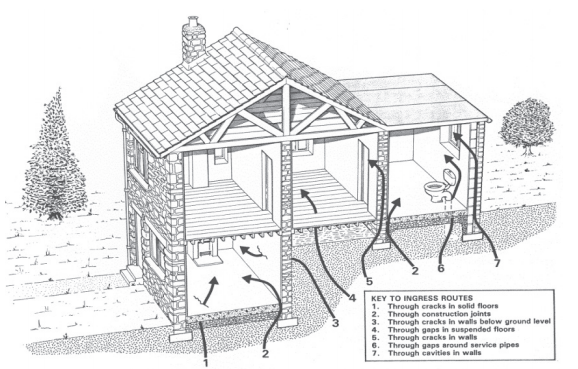
FIG. 1. Radon access routes (image courtesy of the Building Research Establishment (BRE), United Kingdom; reproduced with permission).
3.6.
The distribution of concentrations of 222Rn indoors in dwellings is very wide, typically covering several orders of magnitude. Distributions of concentrations of 222Rn are often found to be log-normal, or close to log-normal, within a State or within a region of a State. In some instances, dwellings may have such high concentrations of 222Rn that the radiation doses received by the residents far exceed the annual dose limits that apply for occupational exposure.
3.7.
The population weighted worldwide arithmetic mean concentration of 222Rn of all origins in dwellings is estimated to be 39 Bq/m3 [16].
3.8.
Emanation of 222Rn from the radium present in building materials will also contribute to the concentration of 222Rn indoors. The relative contribution from building materials is generally more important where the total concentration of 222Rn indoors is low. Radon-222 released from building materials is rarely the dominant contributor to high concentrations of 222Rn indoors.
3.9.
Calculations made for a model masonry house indicate that emanation of 222Rn from building materials contributes, on average, about 10 Bq/m3 to the concentration of 222Rn indoors [17]. This represents approximately 25% of the worldwide average concentration of 222Rn indoors. In the European Union, the typical contribution from building materials to concentrations of 222Rn indoors is estimated to be in the range of 10–20 Bq/m3 [18], corresponding to an annual individual effective dose in the range 0.3–0.6 mSv. In the USA, the contribution from building materials to concentrations of 222Rn indoors is estimated to be in the range of 4–7 Bq/m3 [19].
3.10.
In some exceptional cases, the contribution of 222Rn emanating from building materials to the concentration of 222Rn indoors may be up to 1000 Bq/m3 or higher [18]. In such cases, the corresponding effective dose rate from gamma radiation indoors is highly likely to exceed the maximum value of the reference level for building materials of about 1 mSv/a as specified in para. 5.22 of Ref. [2]. This is discussed in greater detail in para. 3.55 and in Section 4. Radon-222 emanation from building materials can also be controlled.
3.11.
Surface waters usually contain 222Rn in very low concentrations. Elevated concentrations of 222Rn can be found in water drawn from groundwater and from private supplies. The contribution of 222Rn from drinking water to the total concentration of 222Rn indoors is not constant as emanation occurs only while water is being discharged through taps or showers. For this reason, 222Rn released from water is seldom the dominant origin of 222Rn in high concentrations indoors, although high concentrations may occur in the short term. The ingestion of water containing 222Rn is also a potential exposure pathway. Information on reducing high concentrations of 222Rn in drinking water supplies can be found in the WHO Guidelines for Drinking-water Quality [10].
3.12.
It has been reported by UNSCEAR [3] that inhalation of 222Rn released from drinking water contributes, on average, 90% of the estimated dose due to 222Rn in drinking water. In addition, the average effective dose from inhalation of 222Rn released from drinking water into air indoors is approximately 0.025 mSv/a, compared with an average total effective dose due to inhalation of 1.1 mSv/a from 222Rn of all origins and its decay products [3, 17]4 . Therefore, while inhalation is the dominant pathway by which exposure due to 222Rn present in drinking water can occur, the average doses received are usually only a small fraction of the doses from 222Rn indoors of other origins. However, for households with a water supply from deep drilled wells in uranium rich bedrock, the household water supply can be the most important contributor to elevated concentrations of radon in air indoors, giving rise to individual doses of several millisieverts [20, 21].