7.6.
Commodities used or consumed by the public, such as retail and wholesale goods, foodstuffs, and construction materials, might contain radioactive substances. This Safety Guide provides general guidance on the trade of non-food commodities; further supporting technical information is provided in Ref. [6].
7.7.
In accordance with para. 5.1 of GSR Part 3 [1], exposure due to commodities that incorporate radionuclides deriving from residual radioactive material (i.e. from past activities not subject to appropriate regulatory control, or following the termination of a nuclear or radiological emergency) should be managed as an existing exposure situation.
7.8.
Paragraph 5.22 of GSR Part 3 [1] states:
“The regulatory body or other relevant authority shall establish specific reference levels for exposure due to radionuclides in commodities such as construction materials, food and feed, and in drinking water, each of which shall typically be expressed as, or be based on, an annual effective dose to the representative person that generally does not exceed a value of about 1 mSv.”
7.9.
The regulatory body or other relevant authority is required to consider existing guideline levels for radionuclides in food as a result of a nuclear or radiological emergency and existing guideline levels for drinking water (see para. 5.23 of GSR Part 3 [1]). Criteria for radionuclide activity concentrations in food and drinking water (other than in the case of a nuclear or radiological emergency) are provided in Ref. [16].
7.10.
Recommendations on adaptation or lifting of restrictions on non-food commodities implemented during the emergency response phase, including restrictions on the international trade of such commodities, are provided in IAEA Safety Standards Series No. GSG-11, Arrangements for the Termination of a Nuclear or Radiological Emergency [17].
7.11.
For non-food commodities, radionuclides can either be on the external surface or be distributed throughout the volume of the commodity. The management of trade in such commodities could use a screening based approach for decision making, as follows:
As a starting point, the values in table I.1 of GSR Part 3 [1] for moderate amounts of material containing artificial or natural radionuclides, and those in table I.2 of GSR Part 3 [1] for bulk amounts of solid material containing artificial radionuclides, may also serve as corresponding screening values for trade. If measurements demonstrate that activity concentrations are below these levels, trade of non-food commodities can be permitted without further consideration. If activity concentrations in non-food commodities exceed the levels in tables I.1 and I.2 of GSR Part 3 [1], this does not necessarily mean that the trade should be restricted. Instead, it indicates that a case by case assessment is needed to determine compliance with specific reference levels, as required by para. 5.22 of GSR Part 3 [1]. This assessment should be based on realistic exposure scenarios.
In the case of bulk amounts of materials with radionuclides of natural origin, a value of 1 Bq/g for each radionuclide in the uranium decay chain or the thorium decay chain and 10 Bq/g for 40K (table I.3 of GSR Part 3 [1], clearance value) can be used for general screening purposes, although more conservative values may be necessary for building materials. If the measurement results are above these screening values, the requirements established in para. 5.22 of GSR Part 3 [1] are required to be considered.
In the case of non-food commodities with surface contamination, a case by case assessment is needed to determine compliance with specific reference levels, as required by para. 5.22 of GSR Part 3 [1]. This assessment should be based on realistic exposure scenarios and adequate dosimetric models (e.g. see Annex II). As described in para. 5.21 of this Safety Guide, the surface contamination values specified in para. 508 of SSR-6 (Rev. 1) [10] (i.e. 0.4 Bq/cm2 for alpha emitters and 4 Bq/cm2 for beta and gamma emitters and low toxicity alpha emitters) may be considered for use as screening values, where no other options are available, especially where prompt decisions are needed.
7.12.
Confirmation that a non-food commodity meets the screening values described in para. 7.11 should be obtained at the first point of entry into trade. This does not imply the need for systematic monitoring of all traded commodities in every State, but authorities in exporting States should ensure that a system is established to prevent unauthorized trade of commodities with activity levels exceeding nationally established criteria. In general, it should not be necessary for each importing State to implement its own routine measurement programme solely for the purpose of monitoring commodities, particularly if there is confidence in the controls exercised by the exporting State.
7.13.
In cases where there are reasonable grounds for believing that the annual effective dose to the representative person would exceed 1 mSv (see para. 5.22 of GSR Part 3 [1]), the government might still consider facilitation of trade based on societal, economic or other relevant factors, subject to the requirements in national regulations as well as any flexibility inherent in para. 5.22 of GSR Part 3 [1]. In general, to avoid unnecessary barriers to trade, States should coordinate their regulatory strategies (and their implementation of those strategies), including strategies for monitoring commodities. Arrangements should be made to determine the actual activity concentration levels in commodities either by obtaining the information from the supplier or by monitoring activity concentration, as organized by the regulatory body or other relevant authority. Any measurements should be made using appropriate techniques and with equipment capable of measuring activity concentrations at levels below the values specified (see Appendix II).
7.14.
Figure 4 summarizes the main steps in the use of screening values for decision making in the trade of non-food commodities.
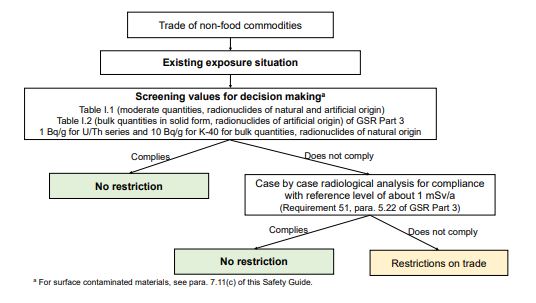
FIG. 4. Flow chart illustrating the use of screening values for decision making in trade of non‑food commodities.