Contents
Regulatory Control in the UK
1. Acts and Legislation
2. Licensing of Nuclear Power Stations |
1. Acts and Legislation
The British civil nuclear power programme followed on directly from the Nuclear Weapons Programme – as such the risk of radiation was already well recognised at the time. Strict government controls were placed on the nuclear industry to protect both the general public and the workers. Such controls were embodied in various Acts of Parliament and have resulted in the today’s safety standards which are far more demanding than for any other industry.
Prior to the announcement of the first civil nuclear power programme in 1955, control of the development of nuclear energy was mainly applied through the Atomic Energy Act 1946 and the Atomic Energy Authority Act 1954. Certain specific areas were dealt with by the Radioactive Substances Act 1948.
After the start of the nuclear power programme, legislation was enacted to give powers for the regulation of nuclear safety. This resulted in the Nuclear Installations (Licensing and Insurance) Act 1959 and the Radioactive Substances Act 1960. The Nuclear Installations Act 1959 was succeeded by the Nuclear Installations Act 1965, which included amendments to take account of the international conventions on legal liability. The 1965 Act was subsequently amended by the Nuclear Installations Act 1969 to take account of certain changes to liability arrangements and to increase the financial limits on liability. The two Acts are known collectively as the Nuclear Installations Act 1965 and 1969.
The Radioactive Substances Act 1948 empowers the Government to control the use of radioactive substances and irradiated apparatus in medicine, industry and research and the transport of such substances and apparatus. The Radioactive Substances Act 1960 regulates the keeping and use of radioactive material and controls the accumulation and disposal of radioactive waste.
The Radiological Protection Act 1970 established the National Radiological Protection board to provide advice and services concerned with radiological protection, and to further the acquisitions of knowledge of protection of mankind against radiological hazards. Radiological safety criteria in the UK are based on the recommendations made by the International Commission on Radiological Protection.
The National Radiological Protection Board has the responsibility within the UK to advise appropriate Government Departments and statutory bodies on the acceptability and applications of the recommendations of the ICRP. The National Radiological Protection Board has endorsed the system of dose limitation that include dose limits proposed by the ICRP as a satisfactory basis for controlling the exposure of persons to ionising radiation in workplaces and in the general environment. The National Radiological Protection Board is now formally responsible for specifying the emergency reference levels in the UK.
The Health and Safety at Work Act 1974 established the Health and Safety Commission and its enforcing arm, the Health and Safety Executive (HSE). The Act, and regulations made under it, transferred functions connected with the licensing, inspection and accidents at nuclear licensed sites from the Secretaries of State to the Health and Safety Executive.
As a member of the European Union, the UK is subject to the European Atomic Energy Community (Euratom). The function of the Euratom is to promote the development of nuclear industries in the Member States by means of research, dissemination of information, operation of joint enterprises, and the control of the supply of ores and special fissile materials. It also has a duty to establish uniform safety standards for the protection of health.
2. Licensing of Nuclear Power Stations
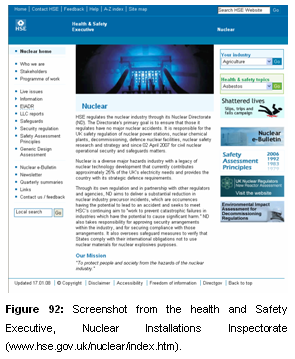
Responsibility for the licensing and inspection of nuclear power stations rests with the HSE. Both these functions are carried out by the Nuclear Installations Inspectorate (NII). The Inspectorate employs qualified inspectors whose duties are to assist in the detailed application of the Nuclear Installations Act 1965 and 1969, and to assure themselves that the conditions of nuclear site licenses are observed. Conditions imposed under the licenses over safety of design, construction, operation and maintenance, and precautions to be taken to minimise injury and damage in the event of an accident.
To obtain a site license for a nuclear power station, the applicant first provides sufficient information to enable to NII to satisfy itself on the safety of the proposed plant and the suitability of the site. If the assessment proves to be satisfactory, the applicant is advised that there are no safety objections to the granting of a license, and a formal application for a license can then be made to the HSE.
In parallel with the formal requirements of the HSE, under Acts of Parliament dealing with the supply of electricity in general, the consent of the Secretary of State is required before any power station, whether nuclear or conventional, can be built of extended. Thus before a nuclear power station can be constructed, the applicant must first obtain the consent of the Secretary of state for Energy.
At the time when an application for consent is made, all interested parties are notified and a press release is issued setting out the intentions of the applicant concerned. At the same time, a Form B is submitted to the local planning authority to obtain its formal views, which are considered by the Secretary of State before a decision is reached on consent. Notice of the application is published in newspapers and also posted in prominent positions around the site. Objectives to the proposal may be made and if these are unresolved with the planning authority, a public inquiry is called for. If, in spite of agreement by the planning authority, there are sufficient objections from other organisations or individuals, then a public inquiry is also called for.
In practice, the applicant would not apply for consent without first confirming with the NII that a site license is likely to be obtainable. However a site license could not be implemented unless the Secretary of State concerned has given their consent for the construction of a station.
Under the power of the NII, the nuclear site license forms a powerful but flexible control over the licensee’s operations from the moment it is issued until revocation. The site license issued for station has relatively few conditions attached to it initially, but includes a requirement that construction of the reactor shall not commence until written consent has been given by the HSE. This is only given when the HSE is satisfied that sufficient information has been submitted to show that the reactor will be acceptable from a safety point of view.
After construction of the station has been completed, the next stage is the commissioning of the plant and bringing the nuclear fuel onto site. For this, written consent of the HSE is required.
A Commissioning Committee is formed under the chairmanship of the Station Manager. Members of the Committee are drawn from the organisations concerned with the safety, design, construction and operation of the station, and thus make up a body with wide experience and comprehensive knowledge of the plant and its characteristics.
Tests are carried out to show that the reactor and ancillary plant have been correctly constructed and installed. These are followed by engineering tests to show that the systems operate satisfactorily together. When these have been successfully completed, the nuclear fuel is loaded into the reactor and the basic design assumptions proved by the careful raising of the reactor power in stages to its designed output.
For the final stages of commissioning when the reactors become operational, the number of conditions attached to the license is increased to about 60, to cover every aspect relating to the safe operation and maintenance of the station and the protection of operating staff and the public.
The NII carries out safety assessments during the phases of construction and operation, and checks that stations are built and operated in accordance with the approved design and the conditions attached to the site licenses.