Discount rate
The process of discounting a stream of cashflows (or quantities of energy) to arrive at the present value (PV) of that stream requires the choice of an appropriate discount rate. Heuristically the discount rate captures the idea that cash which is to be received (or paid) in the future is less valuable in some sense than cash received today.
Consider the figure below:
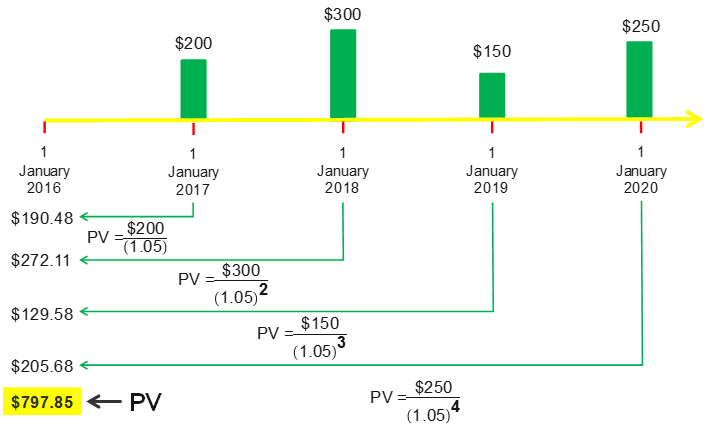
In this figure the sequence of future cashflows [$200, $300, $150, $250] is multiplied, term by term, by a geometric progression [1/(1.05), 1/(1.05)2, 1/(1.05)3, 1/(1.05)4] to arrive at a PV of $797.85. The common ratio in this geometric progression – i.e. 1/(1.05) - is the reciprocal of 1 plus the discount rate; in this example the discount rate is 0.05 or 5%.
A word of caution on usage of ‘discount rate’ is appropriate here: while the phrase is most often used to refer to the value which appears – added to 1 - in the denominator of the common ratio (0.05 in this case) it is sometimes used to refer to the common ratio itself.
Aside from questions of terminology a number of substantive issues and observations may be made about the discount rate. First and foremost, it can be challenging – and perhaps as much art as science - to choose a discount rate for use in calculating the LUECs arising from different bids for a nuclear project.
A more or less formal approach is perhaps most applicable to those projects which are financed purely from the balance sheet of a publicly listed company. In this case it is common to use the company’s own Weighted Average Cost of Capital (WACC) as the discount rate.
The WACC represents the overall cost of financing which would be incurred by a company raising the funds to be invested in a nuclear project. Its calculation takEs into account the relative weightings of equity and debt in the overall amount of financing (i.e how much of the financing will be via share issuance versus how much will be borrowed), and is represented on an after-tax basis by the following formula:
WACC= (kE × share of Equity) + (kD × share of Debt)×[1-t]
where kE represents the estimated cost of equity, kD the estimated cost of debt, and t the tax rate faced by the company (the inclusion of the [1-t] factor reflects the tax deductibility of corporate borrowing). If the company is publicly listed the cost of raising finance by issuing shares - kE - can be estimated using the Capital Asset Pricing Model (CAPM).
Determining an appropriate discount rate is more difficult if – as is often the case – the source of financing for the project includes at least one stakeholder which is not a publicly listed corporation (e.g. a government). In such cases the application of corporate finance principles in what is essentially a project evaluation may not be appropriate.
The UK’s Green Book describes the considerations which underlie the determination of what it terms a Social Time Preference Rate (STPR) for use in evaluating projects financed by government. It is suggested that a rate of 3.5% be used as the discount rate (p.98); it should be noted that this rate is specific to the UK economic context. Crucially the Green Book also lends support to the idea that a declining discount rate should be employed where costs and benefits from a project will continue to accrue over periods in excess of 30 years; given that Generation III nuclear technologies are widely anticipated to have lives of around 60 years this declining discount rate idea is clearly of relevance.
https://data.gov.uk/sib_knowledge_box/discount-rates-and-net-present-value https://www.gov.uk/government/uploads/system/uploads/attachment_data/file/220541/green_book_complete.pdf