Recognizing risks
The process of arriving at a LUEC measure involves making estimates of – or assumptions regarding - a number of key ‘unknowns’ including construction duration (which will determine the IDC component of Total Capital Investment Costs, as well as escalation) and ‘overnight’ capital costs, as well as capacity factors during plant operation, O&M costs, etc. These assumptions will be entered into a financial model (typically developed by financial advisors) and will drive the resulting LUEC calculation.
It is important to recognize that considerable uncertainty underlies some of these key ‘unknowns’ – and thus the ‘true’ value of the cost of lifetime cost of electricity from the modelled nuclear project. This recognition should inform every aspect of the decision-making process – i.e. senior decision-makers should be aware that any estimate of the LUEC associated with a particular technology is inherently uncertain.
There are two main ways to reflect the uncertainty in the assumptions underlying the LUEC value.
The first (and perhaps the most commonly used) is to carry out ‘sensitivity analyses’ on the estimated LUEC number. To do this the key drivers of the LUEC (those assumptions to which the LUEC metric is most sensitive) are identified (e.g. construction duration). ‘Worst case’ (and possibly ‘best case’) values are identified for these assumptions (e.g. a 10-year ‘worst case scenario), based on historical data and/or expert opinion. This value (or these values) is/are plugged into the financial model and the resulting LUEC numbers may be viewed as bounding a range of likely LUEC outcomes.
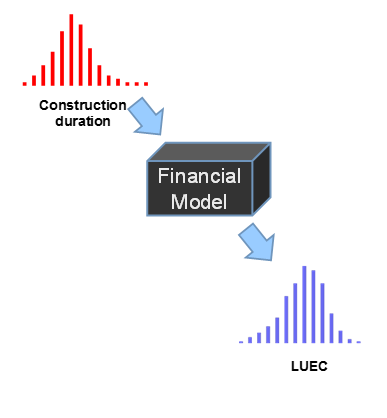
The second (arguably more sophisticated but less widely used) approach to reflecting the uncertainty in the assumptions underlying the LUEC value is to formally characterize these assumptions as random, using the language of probability. The graphic below illustrates this approach; with the uncertain nature of construction durations explicitly acknowledged by characterizing those durations by means of a histogram (possibly based on expert advice). Given the stochastic nature of the inputs to the financial model, the outputs from this model (LUEC metrics) will also be stochastic, i.e. characterized by a histogram.